
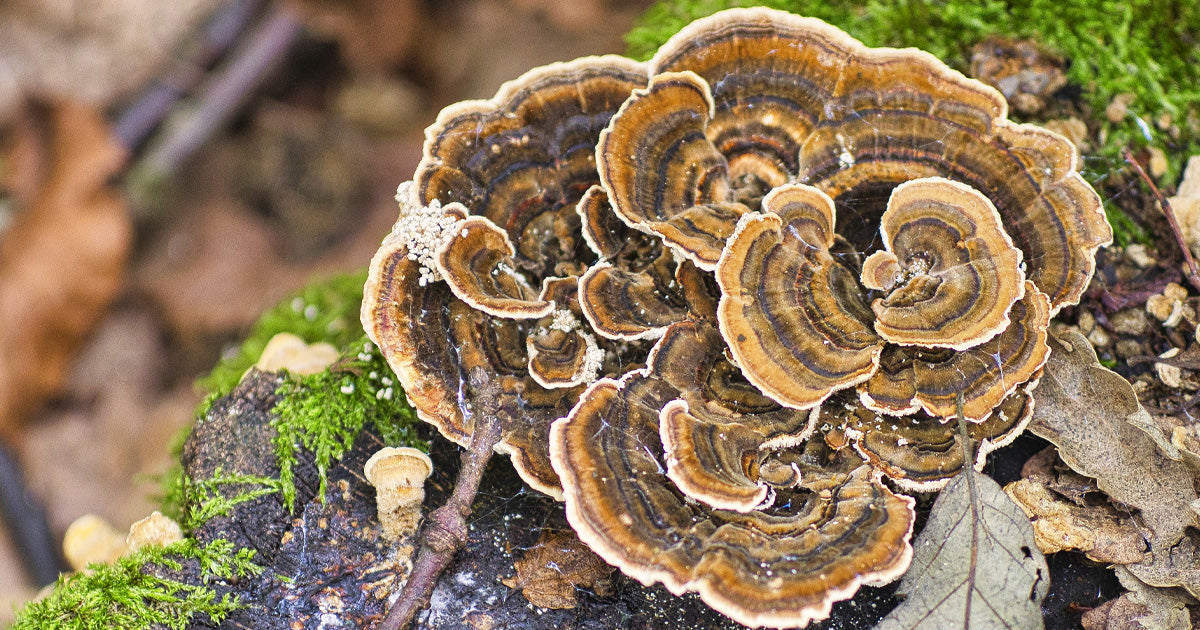
If you've spent any time in hardwood forests, you've seen this mushroom. Trametes versicolor grows on nearly every dead log and stump—those concentric rings of brown, tan, cream, and sometimes blue fanning out like the tail feathers of a wild turkey. We've been harvesting and using this species for over twenty years, and the research has finally caught up to what traditional practitioners have known for centuries.
In Traditional Chinese Medicine, they call it Yun Zhi and use it to replenish vital energy. The Japanese pharmaceutical industry extracts compounds from it for cancer adjunct therapy. Meanwhile, most Americans step right over it on the trail, not realizing they're walking past one of the most studied medicinal mushrooms on the planet.
What Makes Turkey Tail Worth Your Attention
Trametes versicolor is a polypore—meaning it has pores on its underside rather than gills. This matters because it's one of the identifying features that separates true Turkey Tail from its look-alikes. The mushroom is tough, almost leathery, which is why you won't find it sliced up in stir-fries. Instead, it gets prepared as tea, powder, or extract to make the bioactive compounds available to the body.
The compounds that matter are protein-bound polysaccharides—specifically Polysaccharide-K (PSK) and Polysaccharopeptide (PSP). PSK is approved as adjuvant cancer therapy in Japan and has been since 1977. PSP is widely used in China for immune support. Both are beta-glucans, compounds that don't just stimulate immune function but modulate it—helping the body calibrate its response to threats rather than simply ramping everything up.
Five Things the Research Actually Shows
1. Immune System Training
We've heard Turkey Tail described as a "gym" for the immune system, and while that language is a bit cute, it captures something real. Research demonstrates that compounds in Turkey Tail activate Natural Killer cells, macrophages, and T-cells—the heavy hitters of immune defense.
A Phase 1 clinical trial with breast cancer patients showed that daily consumption of Turkey Tail preparation (up to 9 grams) increased counts of CD8+ T cells and CD19+ B cells, suggesting faster immune recovery following radiation therapy. The mechanism involves increased production of cytokines like TNF-alpha and Interleukin-6—signaling molecules that coordinate immune response.
2. Support During Cancer Treatment
We want to be clear here: Turkey Tail is not a standalone cancer treatment. What the research supports is its role as adjunct therapy—used alongside conventional treatments like chemotherapy and radiation, not instead of them.
That said, the data is significant. Meta-analyses of clinical trials show that adding PSK to chemotherapy regimens improved 5-year survival rates in patients with gastric and colorectal cancers compared to chemotherapy alone. Studies also suggest Turkey Tail extracts can mitigate chemotherapy's side effects—reducing fatigue, nausea, and low white blood cell counts. Research has highlighted benefits for gastric, colorectal, breast, and non-small cell lung cancers specifically.
3. HPV Response
Emerging research suggests Turkey Tail may help with Human Papillomavirus. In a clinical trial involving women with HPV-dependent cervical lesions, a vaginal gel containing Turkey Tail extract significantly improved lesion repair compared to the control group. In women over 40—a group with higher risks of viral persistence—the gel showed a 92.3% rate of lesion repair and a positive trend toward clearing the virus.
4. Gut Microbiome Support
A healthy gut underpins a healthy immune system. Turkey Tail acts as a prebiotic, feeding beneficial bacteria in your digestive tract. A randomized clinical trial showed that PSP from Turkey Tail modulated the human gut microbiome—increasing populations of beneficial Bifidobacterium and Lactobacillus while suppressing harmful bacteria like Clostridium and Staphylococcus.
5. Antioxidant and Anti-Inflammatory Activity
Turkey Tail is rich in phenols and flavonoids—potent antioxidants. Laboratory studies found that water extracts demonstrated the highest antioxidant capacity compared to other extraction methods. The polysaccharide-peptides also lower expression of pro-inflammatory markers like COX-2, potentially offering support in inflammatory conditions.
How to Actually Use It
The fruit body is made of chitin—the same stuff in insect exoskeletons. Your digestive system won't extract much from raw Turkey Tail. The bioactive compounds need to be liberated through extraction.
Hot Water Extraction
This is the traditional method and still the most effective for extracting the immune-boosting beta-glucans, PSK, and PSP. These compounds are water-soluble. Simmer dried Turkey Tail in water for several hours—essentially making a strong tea or decoction. This is how we prepare it at home.
Dual Extraction
Some commercial products use both water and alcohol extraction. Alcohol can pull out triterpenes and sterols, but the primary immune-modulating polysaccharides respond better to water. If you're buying supplements, look for products that specify beta-glucan content.
Fruiting Body vs. Mycelium
There's real debate here. Fruiting bodies—the caps you see in the forest—are what traditional medicine used. The pharmaceutical PSK and PSP are often derived from fermented mycelium. The problem: commercial mycelium products are frequently grown on grain, and if not separated properly, you're paying for ground-up rice with minimal fungal compounds. Check labels for beta-glucan percentages. If they don't list them, that tells you something.
Safety and Reasonable Expectations
Turkey Tail has an excellent safety profile. Clinical studies have used daily doses of 3 to 9 grams over extended periods with good tolerance. Some people report:
-
Darkening of fingernails
-
Dark stools (not from blood)
-
Mild digestive upset—bloating or gas
If you're currently undergoing cancer treatment or have immune disorders, talk with whoever is managing your care before adding Turkey Tail to your regimen. These compounds are biologically active, and anyone coordinating your treatment should know what's in the mix.
Field Notes
We've been harvesting Turkey Tail for two decades now, in forests from the Pacific Northwest to the Ozarks. It's one of those species that rewards attention—the more you look, the more you find. And the more you use it, the more you appreciate why traditional medicine held it in such regard.
The science validates what practitioners knew. But don't let the research abstracts distract you from the fundamental practice: getting into the woods, learning to identify what grows there, making simple preparations from what you find.
0 comments